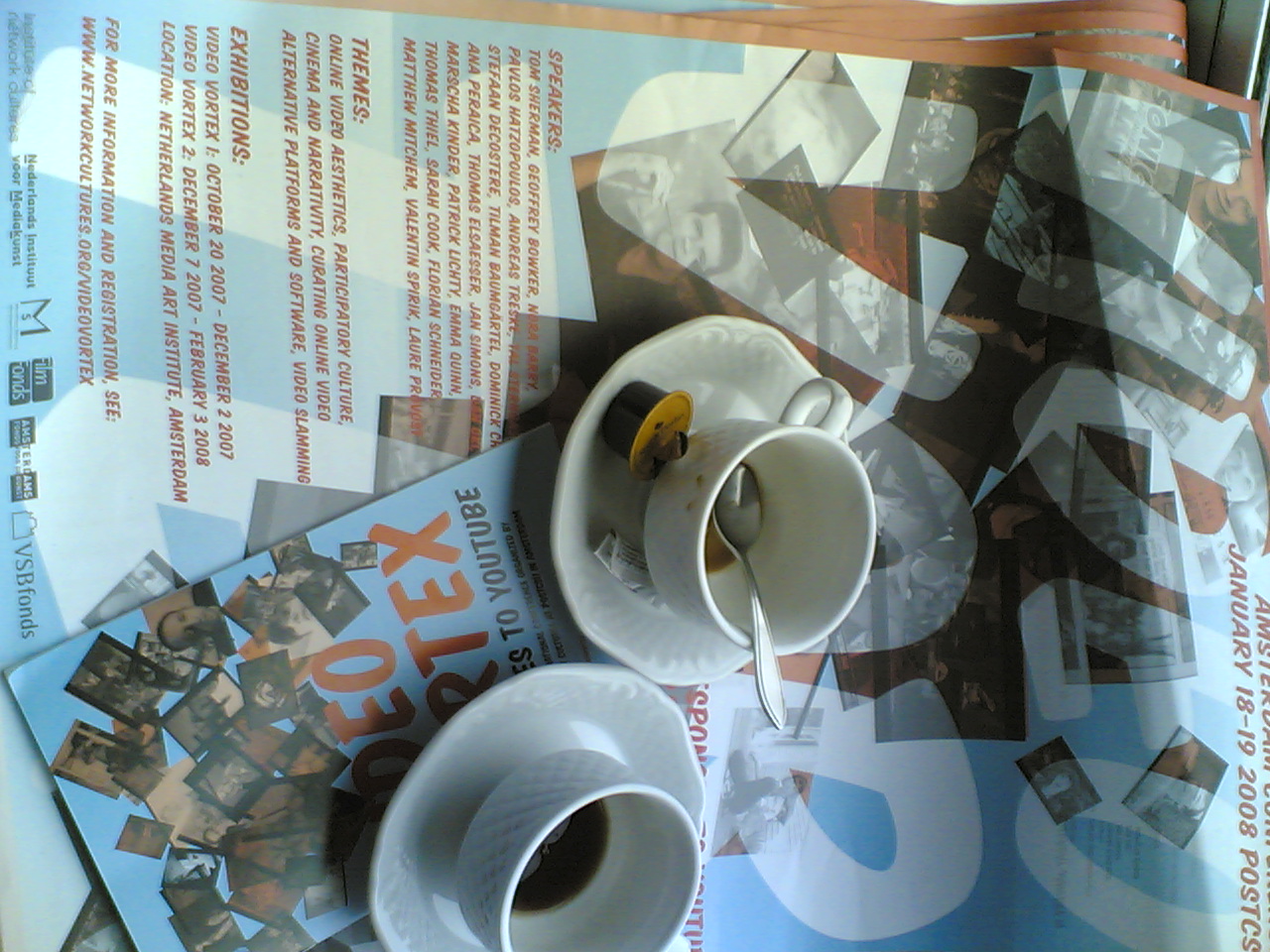
During the January session of Video Vortex, organised by the ‘Institute for
Network Cultures’ in Amsterdam, a big community of networkers met to
discuss how video and contents are being shared nowadays through the
internet. Participation, sustainability and new interaction ways for
artists, producers and audiences were the main topic discussed. Piracy
was also at the margin of the conference peeping and blinking to someone’s
eye. Of course mine was one of them, so I decided to interview on this
topic
Geert Lovink, who was one of the main curator of the event and author of
Zero Comments edited in Italy by Bruno Mondadori, to focus
more of the peer production and on its network.
I edited this dialogue for digimag 32# in an italian translation. As far as I think it might be interesting to read it also in this noblogs platform, I will publish the English version here.
For years now Geert Lovink has been one of the major analysts of that
arena where Internet meets the economy, politics, social action, art.
His prolific activity as a writer and as organizer of international
meetings had made him one of the main promoters of innovative net
culture and of net.art. Already in 1995 he created www.nettime.org
mailing list, which is now recognized as one of the main discussion
forums of the net and of its capabilities. Co-founder of Adilkno
[Foundation for the Advancement of Illegal Knowledge], editor of
Mediamatic magazine between 1989 and 1994, organizer and soul of
Digital City of Amsterdam project, founder of the Institute for
Network Cultures, Geert Lovnik is hard to pin down as a classic
intellectual figure, as he effortlessly moves between academia and
the countercultural scene: he’s on the borders of both, but
certainly not on the margins of either.
He
is author of seminal texts such as Dark Fiber (2002), Uncanny
Networks (2002), My First Recession (2003) e The Principle of
Notworking (2005). Lately Lovnik’s activity has focused on creative
practices and on sharing patterns on the net and through the net. On
the one hand he has thus published texts and articles that deal with
new creative practices, which were born and developed through
Internet with low costs and high visibility, on the other hand
the Dutch intellectual has focused on the phenomenon of Web 2.0, on
practices of content sharing and their organization on the net, on
the ever increasing creative and professional networking activities.
We met Geert Lovnik at the Dutch Video Vortex meeting, and we jumped
on the opportunity to have a chat with him.
espanz: You’ve been studying networks and how people collaborate into
networks, how do you describe, in your analysis, p2p, their communities,
and the
new production of sense they are developing?
GL: We need to make a distinction between the official P2P ideology, in
which I also participate, and the dirty reality. There is a multitude of
reasons why people participate in P2P networks. Also politically there
is a interesting range of people involved in P2P, from the post-modern
poor,
driven by a lack of cash to techno-anarchists to capitalist pro-market
libertarians. In that sense P2P is deeply human. It’s like sex. There
is so many ways of doing it, and the reasons and intensions are so
different,
each time, even within one person. I am not saying the situation is
complex. I do not mind to explain, and defend, the idealistic version of
exchange, anti-copyright, sharing and so on. The fuzzy everyday use of
P2P exchange networks is largely happening outside of any discourse. I see
P2P networks as a temporary autonomous zones, as described by Hakim Bey,
as
they are bound to disappear (in order to reappear elsewhere). I do not
think it is useful to argue that they should be legalized. Maybe this is
because I am from Amsterdam where we have made a lot of interesting
experiments with phenomena that happen in the grey zone between legality
and illegal practices. We have often seen that half-way tolerating
illegal activities is generating interesting situations. Elias Canetti’s
descriptions of how crowds gather and fall apart might help in this
context. Complete legalization often kills the activity and neutralizes
the problematic field up to the point of disappearance. Legalization of
exchange of copyrighted material is not the way to go. What we instead
need is an alternative economy, one in which artists and creative
producers
are financially rewarded directly, without ‘middle men’, for instance
through micro-payments.
espanz: In your essay The Principle of Notworking (2005) you say that
propaganda is not as effective in networks than in other media. Do you
still think that’s true, even considering the extend web 2.0 is
growing? Is it possible that p2p could be a good instrument to empower
people and
develop new channels to distribute sense?
GL: You are right that we witness an unprecedented ‘massification’ of
web platforms with up to 100 million users of a single website. Average
social networking sites have somewhere between 1-5 million users. However,
they
are not online all the time. At any given moment in time there are
around 40.000 people inside Second Life. These numbers might grow and look
different at peak times. Still, they are not grouped together. I believe
that we have left behind the television age where we sit around the fire
together, as Marshall McLuhan once described it. With the exception of
moments like the Olympic Games the Long Tail is bound to get longer. We
will have to get used to this and reconfigure our understanding of what
power
consists of in the distributed age. Power as such does not disappear,
neither does propaganda. What diminishes is the spectacular, celebratory
aspect of it. The trend of indirect, invisible ideology further
continues. It will become really difficult to detect present forms of
subliminal
indoctrination. There is a still a great desire for consumer
capitalism, in particular when it is glamorous and wild. P2P networks are
not a serious
counter force in this game. The fact that one collaborates and exchanges
doesn’t make you a Gutmensch, let alone a revolutionary. For me it is
not enough to ask the question of empowerment. For what? It’s the same
with
this abstract (but appealing) demand for ‘change’? Change in what
direction?
espanz: During Video Vortex 2 in Amsterdam Florian Schneider focused his
speech on the idea of imaginary property. He said that in the digital age
property shifts from the Marxist concept of fetishism towards the idea of
social
relations. To own an image or a medium means to define social relations
and a network. Do you think this can also be applied to P2P communities?
How
could use value and exchange value being rediscussed in this case?
GL: I am not on top of the P2P debate about value. If you follow
interesting forums like iDC on this you would see that Michel Bauwens,
Franz Nahrada and Adam Arvidsson have a lot of interesting insights.
Five years ago it was a German list community called Oeknonux that
discussed
these issues. Oekonux as a project got really far into the debate but
then stalled because the founder and moderator, Stefan Merten, wasn’t able
to
let go of the project and so the context dried up. I can only make some
meta observations. Ever since Baudrillard and others of the 1960s
generation
we have seen a further acceleration of the whirlpool of concepts that were
once developed in the time of Smith, Ricardo and Marx. The political
economy
during the late 20th century has not developed a convincing critical
vocabulary of its own, so we’re still in the midst of the debates around
the different definitions of value, use value, exchange value, surplus
value, price, wealth, and so. If we discuss the economy of free
software/open source and peer2peer networks it makes more sense, as
Arvidsson and others suggest, to investigate ‘accumulated affect’ and
‘sociality’ that result in an economy based on ‘ethical value’ (driven
by brands). I can see this point and do believe that it contributes to a
more equal and sustainable society. It will also mean more media madness,
not less. What I would contribute to the debate (I am not an economist) is
the
‘free cooperation’ concept from Christoph Spehr. This brilliant essay just
came out in an English translation. For me the sociality of the net has to
be
free in that there has to be a way to opt-out. There should not be a
compulsory
element. Contributing for no money has to become a free choice, not the
default setting.
espanz: You address a sharp critique to Lessig’s creative commons production
model. How can collaborative free networks bring about new forms of
production?
GL: I can see the point of Lessig and his creative commons model.
Realistically, it’s something content producers like me can work with.
What I do not agree with is the emphasis in the cc rhetoric on the
innocent
amateur. In my view the amateur is a. not innocent but guilty. There is
a pleasure in downloading and sharing illegal material. I wonder if Slavoj
Zizek has already written about this. And b. the amateur should at
least be given the option of participating in the money economy. If the
amateur,
who earn money with some other job profession in the day time, feels that
he or she want to contribute and share for free, then that’s fine. At the
moment the amateurs are blocking the careers of entire generations of
young
professionals. With this the rich knowledge of professions is
threatened to disappear (for instance those doing investigative
journalism). We have
to stop this talent drain and not create economies that have to live off
charity. Free networks should take themselves more serious. The first
step to get there should be to critically investigate the ‘ideology of the
free’. New forms of production, as you call it, cost money. We need to
circulate money so that it can flow into those circles that have taken
up the task to seriously construct tomorrow’s tools.
http://www.networkcultures.org/geert/
http://www.hva.nl/lectoraten/documenten/ol09-050224-lovink.pdf
http://www.oekonux.org/
L’economia dello scambio sta diventando un modello di business per le mega piattaforme di social network, che, grazie ad esso, riescono a fare utili sulle cyber-relazioni umane.
Le reti egualitarie, invece, quasi totalmente basate sul volontariato gratuito, realizzano modelli a-gerarchichi entusiasmanti anche se poche sono in grado di elaborare pratiche di auto-sostenibilità (economica).
La possibilità di creare valore monetario e la sua circolazione, anche per le reti egualitarie, è un’idea da percorrere con forza.
Tuttavia ritengo che la mancanza di un possibile tessuto produttivo “organico” (mi si passi il termine) non fermerà il movimento culturale dell’open non è free.
Nel complesso le reti libere non corrono il rischio di sparire o di farsi inglobare dalle reti aristocratiche (a meno di reprimerle), perchè sono parte di un movimento sociale auto-istituente, destinato in ogni caso a cambiare il futuro.
ciao Hackpolitik,
capisco il tuo discorso anche se non parlerei di “volontariato gratuito” (free come free speach, sempre!) e non credo che sia vero che le reti informali di cui parli sviluppino modelli a-gerarchici toutcourt, anche se concordo con sul fatto che siano entusiasmanti, che mettano in circolo grandi energie e che in questo risieda la loro ricchezza anche in termini di produzione materiale.
Andrebbe approfondita tutta la questione, nel mio caso la cosa parte da riflessioni condotte altrove e qui praticamente ringrazio e dedico l’intervista ad alcuni miei compagni, in particolare bomboclat ed elanor, ma ce ne sono molti altri con cui si e’ costruita negli anni di lavoro fra reload pergola e cw a Milano, un interessante percorso di discussione e sperimentazione sulle questioni dell’autoreddito, della produzione sociale e dell’outlet sociale (quest’ultimo mai veramente messo in atto, ma indagava proprio come la questione della produzione investiva ad un tempo la materialita’ e l’mmaterialita’, l’idea della produzione di senso e di modelli autonomi).
Continueremo a lavorarci su.